galerie Willy Schoots: Slow Sculpture in Speedy Times (solo)
The presentation Slow Sculpture in Speedy Times, includes an impressive overview of the oeuvre of Willem Harbers, between 2007-2011. In close collaboration Willem Harbers and Roland Janssen, have chosen for a particular composition and structure, which offers the visitor the opportunity to watch over the shoulder of the sculptor and gain insight into his considerations when creating his work. Along with the exhibition the Catalogue Slow Sculpture in Speedy Times will see the light. In it, the impact of an extensive interview with Willem by Peter Henk Steenhuis, writer and publicist. Many of the presented works are discussed in the catalogue. Steenhuis knew like no other, to get the best from Willem Harbers and write it down in plain language; about Moby Dick and submarines, motherofpearl and powder coatings. The exhibition will open on Sunday, April 10th, 2011 at 16:00 pm by Willem Harbers, with a brief explanation of his recent work. The team at Galerie Willy Schoots and Willem Harbers hope to welcome you on this occasion.10.04.2011 – 14.05.2011
Galerie Willy Schoots International modern and contemporary Art Willemstraat 27, 5611 HB Eindhoven T 040-244 97 05
[gallery ids="8659,8654,8653"] [clear]For the download of the interview by Henk Steenhuis click here:Willem Harbers Slow Sculptures In Speedy Times - the complete interview with Henk Steenhuis.
While driving, on our way to Willem Harbers' exhibit, we try to find the words to describe his sculpture work. We come up with authenticity & uniqueness, quality & enjoyment, content & depth, slow pace & balance. Splendid concepts, but also dangerous ones, since they quickly turn hollow and vacant. Who doesn't want enjoyment, who won't pursue quality, and isn't in search of content, depth, and balance? Is it possible to realise such a dream? Make it definite? And can art play a role in this? “Yes,” says Willem Harbers, “ A sculptor is by definition slow, the material with which they work is slow, and the beholder can only enjoy the work if he or she takes their time, stays with the sculpture, walks around it, slows their step, views the work from all angles, or otherwise: becomes slow themselves.” To explain why a sculptor is a slow artist, Harbers makes a comparison with the sketch artist. “If you want to learn to draw then during a course you can make as many as fifty charcoal sketches in one evening. That is equal to fifty end products. If I work hard, I can produce 10 sculptures per year.” Harbers began as ceramicist: in 1994 he won the competition for young artists of the Ceramics Centre of Den Bosch. “Clay is a slow material. That is because clay has memory. If you don't start with dividing the clay equally, first pressing hard here and then pressing lightly there, then the clay product will come out of the oven with bubbles, because, while in the oven, pressed clay will expand and dent in where it was smoothed out. The mistake you made at the start of making your sculpture will only be seen after the piece comes out of the oven. If you want to work with clay, you must start the thinking process while removing the clump of clay from it's plastic wrapping.”- 3
 Gyroclaaf LG1
The two marble blocks draw all the attention. They look like cylinders. But what are they doing in this steel? Are these marble cylinders perhaps recharging, just like a cordless drill? Or is this steel appliance draining energy from the stones?
“By suggesting that something is charging or discharging, as an observer you get the idea that there is an exchange of energy taking place. The energy centre could be the large steel reservoir or compartment above the marble cylinders.”
Gyroclaaf LG1
The two marble blocks draw all the attention. They look like cylinders. But what are they doing in this steel? Are these marble cylinders perhaps recharging, just like a cordless drill? Or is this steel appliance draining energy from the stones?
“By suggesting that something is charging or discharging, as an observer you get the idea that there is an exchange of energy taking place. The energy centre could be the large steel reservoir or compartment above the marble cylinders.”
- 5
 Ahab
We walk towards a white sculpture, that immediately can be associated with a submarine, with two wing nuts at the ends.
Harbers: “I love thick books, in which you read a long time. They guide the process of making your own visual arts, taking the same time span. The Magic Mountain by Thomas Mann, for example, or Melville's Moby Dick.
Ahab
We walk towards a white sculpture, that immediately can be associated with a submarine, with two wing nuts at the ends.
Harbers: “I love thick books, in which you read a long time. They guide the process of making your own visual arts, taking the same time span. The Magic Mountain by Thomas Mann, for example, or Melville's Moby Dick.
- 8
- 9
- 13
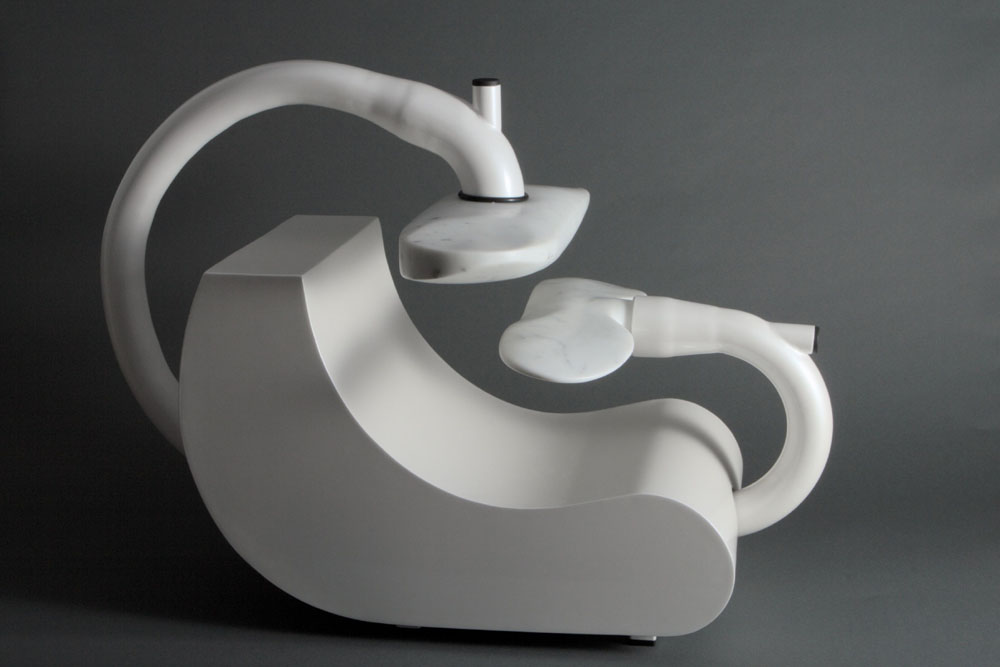
 Introscoop
I was coincidentally in the gallery where the sculpture was standing. Because the woman kept looking at the sculpture – I believe at least a quarter of an hour/fifteen minutes – I approached her: “What do you think?' I did not tell her I was the creator, I found that to vain.
'You know what,' she answered, 'I feel as if I can breathe again.' Of all the responses I have had to my sculptures, this one is most complimentary.”
Why?
“That is difficult to say, but it is about the essence of my work. That's why I will try to make an effort to explain this. We live in fast times. I'm not complaining; I don't judge speed; I even enjoy it.
This speed is a direct result of the industrial revolution. Just look at the marble quarries in Carrara.
Marble mining has taken place here for 2000 years, and that has been in the same way for the past 1900 years: with hammer and chisel slabs of marble are broken off, and brought down the mountain by horse and wagon. The past century has seen the introduction of one machine after the other. Mining marble is now quicker and more efficient: in the past hundred years more marble has been extracted than in the nineteen centuries before.
It is difficult to ignore that this speed brings with it haste. My work is often reminiscent of machines, but they are not machines that speed up our lives but slow it down. They are stationary machines. It could very well be that the response of this woman was a result of a delay, or slowness within her, of a certain introspection.”
The title of this work is 'Introscoop'.
“This telescope doesn't look to the universe, but within. And he who takes the time to look within, slows pace. This delay, or slowing was the core of the compliment that was given to me by this woman. I ask time from viewers. I ask my viewers to make an effort. Not for me but for themselves. If they do, they will slow down, and as a result they can breathe again. That is the compliment of the woman: she gave my work the attention.”
And she could breathe thereafter. That seems to me very useful.
“Even stationary can be useful.”
p.15
In the distance, at the further end of the room, stands a sculpture that appeals to me from the moment we entered the room, a kind of laboratory. Before we approach it we stand still by Monochronique, 2009, which Harbers spoke of earlier. In this striking coloured work only a small stump of marble is visible.
Introscoop
I was coincidentally in the gallery where the sculpture was standing. Because the woman kept looking at the sculpture – I believe at least a quarter of an hour/fifteen minutes – I approached her: “What do you think?' I did not tell her I was the creator, I found that to vain.
'You know what,' she answered, 'I feel as if I can breathe again.' Of all the responses I have had to my sculptures, this one is most complimentary.”
Why?
“That is difficult to say, but it is about the essence of my work. That's why I will try to make an effort to explain this. We live in fast times. I'm not complaining; I don't judge speed; I even enjoy it.
This speed is a direct result of the industrial revolution. Just look at the marble quarries in Carrara.
Marble mining has taken place here for 2000 years, and that has been in the same way for the past 1900 years: with hammer and chisel slabs of marble are broken off, and brought down the mountain by horse and wagon. The past century has seen the introduction of one machine after the other. Mining marble is now quicker and more efficient: in the past hundred years more marble has been extracted than in the nineteen centuries before.
It is difficult to ignore that this speed brings with it haste. My work is often reminiscent of machines, but they are not machines that speed up our lives but slow it down. They are stationary machines. It could very well be that the response of this woman was a result of a delay, or slowness within her, of a certain introspection.”
The title of this work is 'Introscoop'.
“This telescope doesn't look to the universe, but within. And he who takes the time to look within, slows pace. This delay, or slowing was the core of the compliment that was given to me by this woman. I ask time from viewers. I ask my viewers to make an effort. Not for me but for themselves. If they do, they will slow down, and as a result they can breathe again. That is the compliment of the woman: she gave my work the attention.”
And she could breathe thereafter. That seems to me very useful.
“Even stationary can be useful.”
p.15
In the distance, at the further end of the room, stands a sculpture that appeals to me from the moment we entered the room, a kind of laboratory. Before we approach it we stand still by Monochronique, 2009, which Harbers spoke of earlier. In this striking coloured work only a small stump of marble is visible.
 Monchronique
Harbers: “Here you see a sculpture where, for the first time, I used a lot of wood. Firstly because it is difficult for me to make such turned forms in stone, but also because wood has a different sentiment. I hear that in the reactions I get on this sculpture: protective, compassion, soft.”
Monochronique. From the title you think of mono-chromatic, but also of a chronicler, who tells a story. Which story is that?
“I regularly give lectures on marble, marble mining, and my own experiences with marble. At one of my last lectures I showed this picture as an example of my recent work. “You're very engrossing when speaking about marble,” someone told me, “but in your own work you use less and less marble. In Monochronique its only a stump of marble!”
It's true, I say, that in quantity there is little marble in the sculpture, but the stump has great importance. Without that stump, the sculpture would be entirely different. It's not about the amount but the meaning of marble in my work.
Besides that, I must admit that material comes after my ideas. There can come a time when I'll make sculptures without marble, because it no longer has a function. I've no idea, that's part of the adventure.”
We continue walking, towards the largest installation in the room: the Labogrigneur, a series of large white sculptures consisting of tubes or pipes. Not a stationary machine, but a stationary or frozen laboratory.
“No, you could call a laboratory the successor of an engine room, filled with machines. In the Boterhal in Hoorn, I had a solo exhibition in 2005 which consisted of independent sculptures arranged as a workshop of machines. Thus the individual sculptures created an entity. You could arbitrarily “use” them, producing diverse “brain functions”.
Now we come to the Labogrigneur. The various parts form one entity. They can be randomly arranged together. Compact or spread out. Intense or calm. Dangerous or peaceful. In the engine room a certain arrangement determines a certain outcome. A 'laboratory' is a collection of objects with which you can determine insights, conclusions, definite answers, and so forth, if properly used, and with the proper manner of thinking.”
Monchronique
Harbers: “Here you see a sculpture where, for the first time, I used a lot of wood. Firstly because it is difficult for me to make such turned forms in stone, but also because wood has a different sentiment. I hear that in the reactions I get on this sculpture: protective, compassion, soft.”
Monochronique. From the title you think of mono-chromatic, but also of a chronicler, who tells a story. Which story is that?
“I regularly give lectures on marble, marble mining, and my own experiences with marble. At one of my last lectures I showed this picture as an example of my recent work. “You're very engrossing when speaking about marble,” someone told me, “but in your own work you use less and less marble. In Monochronique its only a stump of marble!”
It's true, I say, that in quantity there is little marble in the sculpture, but the stump has great importance. Without that stump, the sculpture would be entirely different. It's not about the amount but the meaning of marble in my work.
Besides that, I must admit that material comes after my ideas. There can come a time when I'll make sculptures without marble, because it no longer has a function. I've no idea, that's part of the adventure.”
We continue walking, towards the largest installation in the room: the Labogrigneur, a series of large white sculptures consisting of tubes or pipes. Not a stationary machine, but a stationary or frozen laboratory.
“No, you could call a laboratory the successor of an engine room, filled with machines. In the Boterhal in Hoorn, I had a solo exhibition in 2005 which consisted of independent sculptures arranged as a workshop of machines. Thus the individual sculptures created an entity. You could arbitrarily “use” them, producing diverse “brain functions”.
Now we come to the Labogrigneur. The various parts form one entity. They can be randomly arranged together. Compact or spread out. Intense or calm. Dangerous or peaceful. In the engine room a certain arrangement determines a certain outcome. A 'laboratory' is a collection of objects with which you can determine insights, conclusions, definite answers, and so forth, if properly used, and with the proper manner of thinking.”
- 19
 Labogrigneur
“The Labogrigneur reveals where I as a sculptor now stand: I use all sorts of materials: marble, wood, metal, plastic. I combine shapes: round, square, oval. You could say that the various parts that characterize each of the other individual sculptures, are combined in this one sculpture. What I find very important is that the Labogrigneur is different from each angle. The biggest difference between a sculpture and a painting is that a sculpture is three-dimensional. That is the quality that I try to exploit. The oval steel shape has a different effect when you stand in front of it than when you look through it from above. Then it becomes a kind of magnifying glass, as my daughter said.”
Everything anew in white, back to square one.
“That seems so. This sculpture is entirely sprayed with mother-of-pearl enamel, an old-fashioned, expensive, slightly transparent enamel, applied over a layer of white paint which, in turn, is sprayed over adhesive primer. The pearl enamel acts as a topcoating, which collects all the colours.
We call it white, but that is incorrect. If you were to look at the sculpture in the sun, you would see some red, some blue, a little bit of yellow, very subtle. This diversity in colours makes the sculpture dynamic; nowhere does the sculpture appear the same. That was exactly what I wanted to realise: the hoses that connect the various parts had to appear flexible, even suggest they were flowing with liquid. This was achieved thanks to the pearl enamel coating. Earlier we discussed the concept 'slow'. This certainly applies to the Labogrigneur. I work with various materials, various kinds of paints, with various colours, in various shapes. It took a lot of time to learn the various properties of all these materials, and learn to work with them. That calls for craftsmanship which requires several years. Or better said: it takes years before you can make slow sculptures quickly.”
Labogrigneur
“The Labogrigneur reveals where I as a sculptor now stand: I use all sorts of materials: marble, wood, metal, plastic. I combine shapes: round, square, oval. You could say that the various parts that characterize each of the other individual sculptures, are combined in this one sculpture. What I find very important is that the Labogrigneur is different from each angle. The biggest difference between a sculpture and a painting is that a sculpture is three-dimensional. That is the quality that I try to exploit. The oval steel shape has a different effect when you stand in front of it than when you look through it from above. Then it becomes a kind of magnifying glass, as my daughter said.”
Everything anew in white, back to square one.
“That seems so. This sculpture is entirely sprayed with mother-of-pearl enamel, an old-fashioned, expensive, slightly transparent enamel, applied over a layer of white paint which, in turn, is sprayed over adhesive primer. The pearl enamel acts as a topcoating, which collects all the colours.
We call it white, but that is incorrect. If you were to look at the sculpture in the sun, you would see some red, some blue, a little bit of yellow, very subtle. This diversity in colours makes the sculpture dynamic; nowhere does the sculpture appear the same. That was exactly what I wanted to realise: the hoses that connect the various parts had to appear flexible, even suggest they were flowing with liquid. This was achieved thanks to the pearl enamel coating. Earlier we discussed the concept 'slow'. This certainly applies to the Labogrigneur. I work with various materials, various kinds of paints, with various colours, in various shapes. It took a lot of time to learn the various properties of all these materials, and learn to work with them. That calls for craftsmanship which requires several years. Or better said: it takes years before you can make slow sculptures quickly.”
- 20