Roughly one hundred years ago, the Dadaist Raoul Hausmann created his most famous work, the Mechanical Head (The Spirit of our Time): the “modern human” as a cyborg. The work bears witness to Modernism’s ambivalent embrace of industrialization and technology as catalysts of what Aldous Huxley would later describe as dystopian in his groundbreaking novel Brave New World (1931).
Today, much of what was fantasy one hundred years ago has become reality. Hybridity in the form of prostheses has become commonplace and almost omnipresent. Advances in medicine have improved our life expectancy to such an extent that immortality seems to be within reach. As in the biblical story of Creation, humankind has once again eaten the fruit of the tree of knowledge. The consequences are well known.
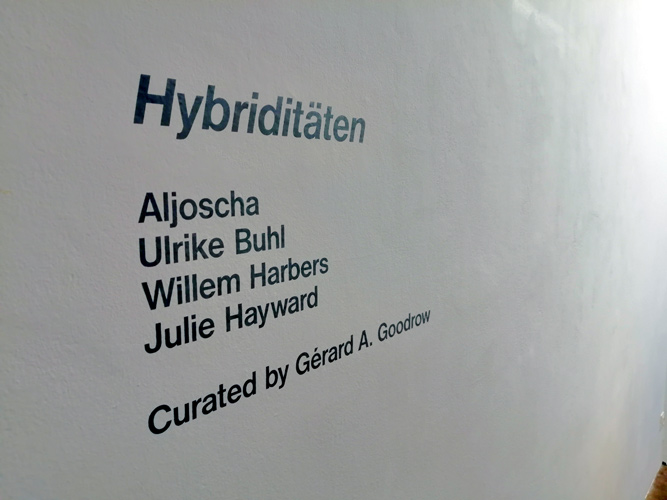
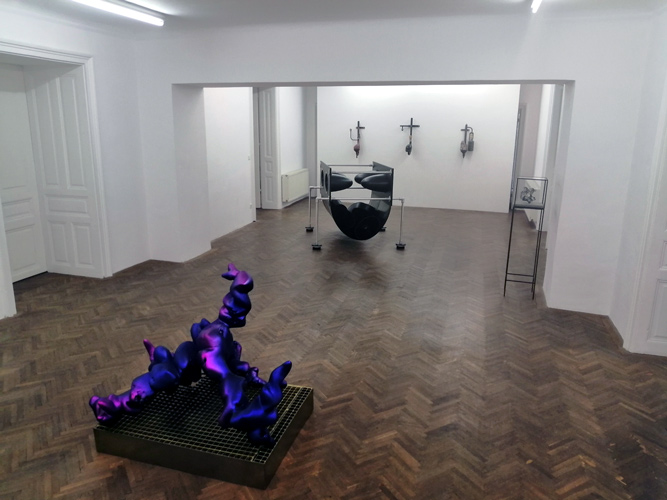
In completely different yet related ways, the four artists in the exhibition address the concept of hybridity as “the spirit of our time.” Four artists, whose works are situated on the borderline between the organic and the technoid, deliver visions of the future, which, depending on one’s point of view, could lead to pleasure and delight in the aesthetic results or to fear of once again being banished from paradise.
The objects and installations by the Dutch sculptor Willem Harbers (b. 1967) are reminiscent of eccentric machines and other mechanical devices that appear retro and future-oriented at the same time. His works evoke ambiguous associations—from precision engineering tools to internal organs, from technoid apparatuses to organic formations.
The Ukrainian artist Aljoscha (b. 1974) uses viscous acrylic paint to create curious, seemingly organic figures and paints fantastic landscapes that oscillate between Surrealism and science fiction. Harbinger of a time in which the studio becomes a laboratory where artists create life?
The whimsical sculptural works by the German artist Ulrike Buhl (b. 1967) are likewise characterized by an organic—or rather biomorphic—formal language. We are dealing here with structures that appear to emerge out of themselves, as if they had an inner tendency to constantly develop further, driven by a mysterious inner force.
With her work I can’t see you(2019), Julie Hayward (*1968) implies that art has its own consciousness and even its own sense of sight. The work is comprised, however, of MDF, aluminum, and foam rubber—all inorganic materials that (according to current knowledge) cannot be brought to life. Simultaneously technoid and organic, masculine and feminine, the Austrian artist’s works occupy a category of their very own.